The One Big Weekend Project Myth
The one big weekend project myth makes home plans brittle. Break work into finishable stages so each session has a clear boundary and next move.
The one big weekend project myth turns a sensible home improvement into a pass-or-fail event: clear the weekend, finish everything, and hope nothing interrupts. A more workable plan starts by naming a small stage you can complete, inspect, and leave in a stable condition—even if the larger project takes several sessions.
That shift matters because a project is not just its visible result. It also includes setup, materials, decisions, cleanup, and the handoff between work sessions. These seven planning moves help you give each part a realistic place.
1. Define the stage by its finish line
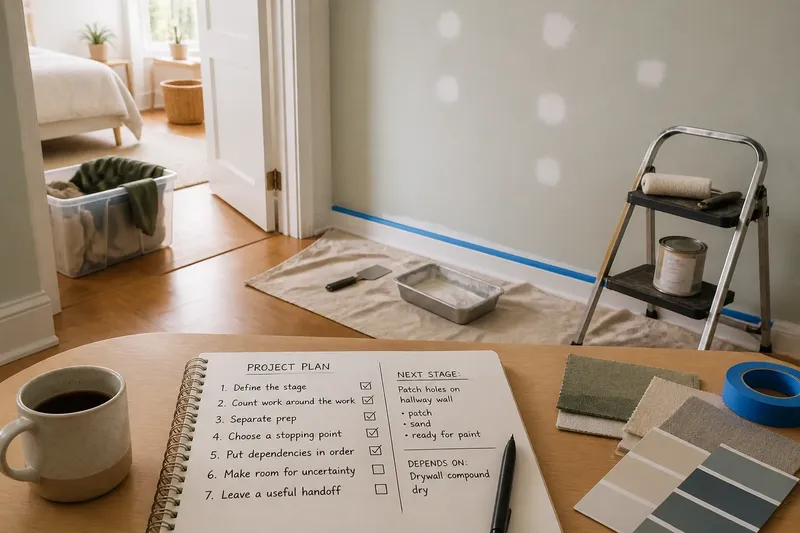
“Work on the hallway” is not a finish line. “Remove the loose hooks, patch their holes, and leave the wall ready for paint” gives the session a boundary and a visible result. A useful stage is small enough to describe in one sentence and concrete enough that you can tell when it is done.
Keep the larger goal in view, but resist turning it into a single weekend promise. If the goal is to refresh a spare room, separate clearing the floor from repairing the trim and painting. Each stage can move the room forward without pretending the whole job fits one uninterrupted stretch.
2. Count the work around the work
People often picture only the central task: sanding a table, hanging shelves, or painting a wall. The plan also needs room for moving furniture, finding the right tool, protecting nearby surfaces, making choices, and putting the space back into usable order. Those surrounding tasks are not distractions; they are part of the project.
Before you commit to a stage, write down what has to happen before the hands-on work and what must happen afterward. If the stage depends on a cleared room, a dry surface, or a chosen finish, put that dependency in the plan rather than assuming it will take care of itself.
3. Separate preparation from the satisfying middle
Preparation can feel like a slow start, especially when the appealing part is visible transformation. Yet gathering the right supplies, checking what you already own, and choosing a stopping point can make a short work session useful rather than frantic. A planned preparation stage also gives you a chance to notice missing information before the room is disrupted.
For example, say you want to repaint a closet. You might first empty one shelf, check the paint label and available brush, and decide which section can be cleared without blocking access to the rest of the room. The expected observable result is a ready-to-start area and a clear list of what remains—not a half-painted closet and a fresh scramble for supplies.
4. Choose a stopping point that leaves the home usable
A stage should end in a condition you can live with. In a kitchen, that may mean clearing and cleaning one cabinet rather than emptying every cabinet at once. In a bedroom, it may mean finishing one wall while keeping a path to the door and access to everyday belongings.
Think about what the household needs while work is paused. If a project occupies a shared room, agree on the area that must remain clear and what can stay out between sessions. A modest boundary can prevent a home project from quietly taking over spaces that other people rely on.
5. Put dependencies in order
Some tasks cannot sensibly begin until another decision or task is complete. A wall may need repair before paint; shelves may need a final location before you choose their arrangement. List these dependencies in plain language so the next action is obvious when you return to the project.
Keep the sequence flexible where it can be. If you are waiting to choose a paint color, you may still be able to sort the room or label items that will be stored elsewhere. The point is not to fill every pause with activity; it is to distinguish a genuine blocker from work that can proceed independently.
6. Make room for uncertainty without making a giant buffer
Home tasks can reveal something unexpected: a surface needs more preparation, a part does not fit, or the first plan proves awkward in the actual room. A schedule that assumes perfect conditions has no place for these discoveries, while a plan that treats every possibility as a crisis becomes hard to use.
Instead, identify the most likely unknown and decide what you will do if it appears. You might pause before buying finish materials until you confirm the surface is ready, or set aside a separate decision session if the layout is still unclear. The response can be modest: record the question, protect the unfinished area, and choose the next stage after you have the information.
7. Leave a useful handoff to your future self
When a stage ends, note what is complete, what remains, and any decision that is still open. A short note on a household task list can say “closet shelf cleared; confirm paint choice before prep” without becoming a full project dossier. This is especially helpful when another household member may pick up the work or when several days pass before you return.
Keep the note close to the place your household already uses for shared tasks, rather than creating a separate tracking system just for one small project. It should make the next action easier to remember, not create administrative work that competes with the work itself.
What should a realistic home project plan answer?
How small should a project stage be?
Make it small enough to finish and leave in a stable condition during a work session you can realistically protect. If the stage contains several unrelated tasks, split it until each part has a clear result.
Should I buy every supply before starting?
Gather what the next stage requires, but avoid buying materials for later decisions that are still unsettled. Check product labels and manufacturer instructions where relevant; local rules or the nature of the work can call for qualified professional advice.
What if a stage takes longer than expected?
Stop at a safe, usable boundary and revise the next stage rather than treating the original plan as a debt. Note what caused the delay so you can account for that condition in the remaining work.
Is a large project ever worth doing in one push?
Some straightforward tasks may suit a continuous session, especially when the space and household schedule allow it. The useful question is whether the work can be completed and left in good order without relying on perfect conditions or an unbroken day.
Skip elaborate tracking for a small job
Not every home project needs a spreadsheet, color-coded timeline, or a separate binder. For a simple task, a sentence on the household list and a short note about the stopping point may be enough. Add detail only when it resolves a real coordination problem, a dependency, or an open decision.
The one big weekend project myth fades when progress is measured by a finished stage rather than a dramatic before-and-after reveal. Choose the next boundary, make the handoff clear, and let the larger result grow through manageable sessions. That small shift gives your plan a better chance of fitting the home you actually live in.