From House Book to Digital Folder: A Short History of Home Records
Trace how home records shifted from handwritten house books to digital folders, and see how changing tools reshaped household memory and access.
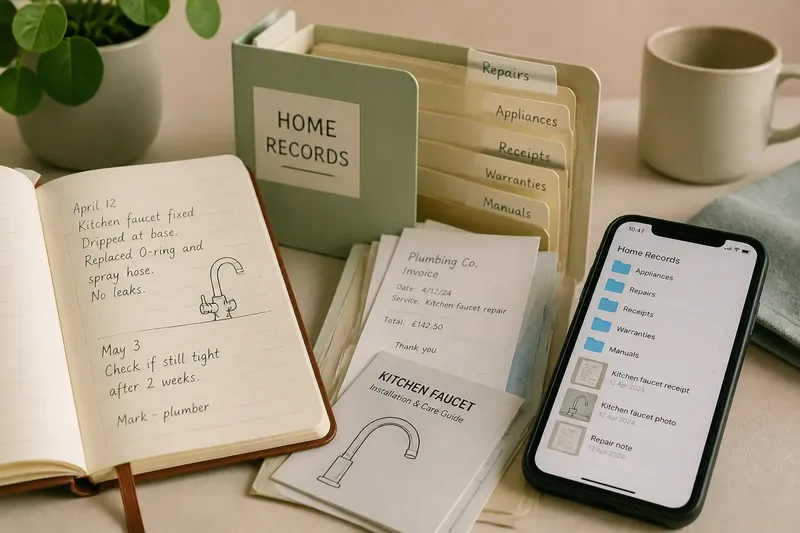
Home records changed as the tools around the household changed: a handwritten house book could hold a repair note, while a digital folder can keep a photo of the same repair beside an emailed receipt. The history of home records is not a clean march from paper to screens; older and newer forms have often served different purposes side by side.
House books kept household memory in one place
Before householders relied on digital devices, a notebook could act as a compact memory aid. Its pages might hold appliance details, reminders, repair notes, or a record of who had worked in the home. What went into a house book depended on the household and the person who maintained it.
Handwriting made adding a thought immediate, and a page could accommodate a sketch or a note in the margin. But the book was useful only if someone knew where it was and could make sense of its entries. A clear date or subject heading mattered as much as the paper itself.
Documents often lived elsewhere. Receipts, manuals, letters, and warranties could be kept in envelopes, boxes, or drawers, leaving the house book to capture brief context rather than preserve every paper. This distinction helps explain why a single format rarely did every job.
Paper folders made documents visible and tangible
When a record arrived on paper, keeping it on paper was straightforward: a receipt could go into a folder, and a manual could stay with related correspondence. A label on a binder or file gave household members a visible clue about where to look.
Paper storage also reflected the physical limits of a home. A folder could be passed across a kitchen table, but the person who knew the filing arrangement might be the only one who could retrieve a particular document quickly. The system depended on labels, habits, and shared knowledge.
There was no single moment when the house book gave way to the filing cabinet. They could coexist, with a notebook carrying reminders and folders holding documents. In practice, households adapted their records to the materials they received and the routines they already had.
Digital tools changed how records were created and retrieved
As phones and computers became ordinary tools for communication and recordkeeping, household information increasingly arrived as email, photos, and electronic documents. A repair appointment might be confirmed in an inbox; an appliance label could be photographed instead of copied by hand. This is a broad description of changing habits, not a claim that every household followed the same timeline.
Digital storage loosened the connection between a record and a particular drawer. A saved file could be copied or opened from another device, and search could locate text in a filename or message. Yet a vague name such as “IMG_4821” offers little help when someone needs to identify which appliance appears in the photograph.
The change also altered what counted as a record. A photo, a short note, and a message confirming a repair could carry useful context alongside a scanned manual. Household memory became distributed across devices and accounts, making access and organization part of the recordkeeping problem.
Home records changed in three important ways
The shift from notebooks and folders to digital storage changed more than the container. It affected when details were captured, how people searched for them, and who could reach them.
- Capture: A handwritten note usually began when someone sat down to write. A phone photo or message could preserve a detail at the moment it appeared.
- Search: Paper encouraged browsing by page or folder label. Digital search added filenames, dates, and text as possible clues, though image-only scans may not be searchable.
- Sharing: Paper could be handed to someone nearby. Digital copies could be shared remotely, but only if the recipient had access to the relevant account or folder.
- Continuity: A notebook or file cabinet depended on its physical location. Digital records depended on devices, accounts, and clear enough names to remain recognizable.
Not every scrap needs to be scanned. Copying material that no one is likely to consult can produce a second pile of clutter without adding useful context; the format shift matters most for records that help someone understand or care for the home.
How do old and new record formats differ?
What did a house book do that a folder did not?
A house book could connect small observations over time, such as a note about a repair followed by a reminder to check the result. A folder was better suited to keeping the actual papers together, so the two formats could complement rather than replace one another.
Why did digital records spread into household routines?
Digital communication and devices made it natural for some household details to begin as messages, photos, or files rather than paper. That shift happened unevenly, and it did not make physical records unnecessary.
Did digital storage make household records easier to find?
It created new ways to search, including filenames and text, but a digital record can still be buried in an inbox or saved under an unclear name. Search helps only when the item has a useful clue attached to it.
Why do some homes still keep paper records?
Paper keeps original documents tangible and easy to handle without signing into an account or using a device. Some households also find a labeled binder or notebook easier to share and maintain.
A small repair shows how the formats can overlap
Imagine a household with a handwritten note reading “kitchen faucet fixed,” a paper receipt in a mixed drawer, and no record of where the original product paperwork went. They scan the receipt, name the file “kitchen faucet receipt,” and add a short note stating that the original paperwork remains in the drawer. The result is a digital clue for searching and a physical location for the paper, without pretending that the scan replaces the original.
That modest arrangement captures the history more accurately than a story of total replacement: household records keep changing as tools and routines change, while the need to preserve context remains. When choosing among a notebook, a folder, or a digital file, the useful question is what clue the next person will have when they need the record.